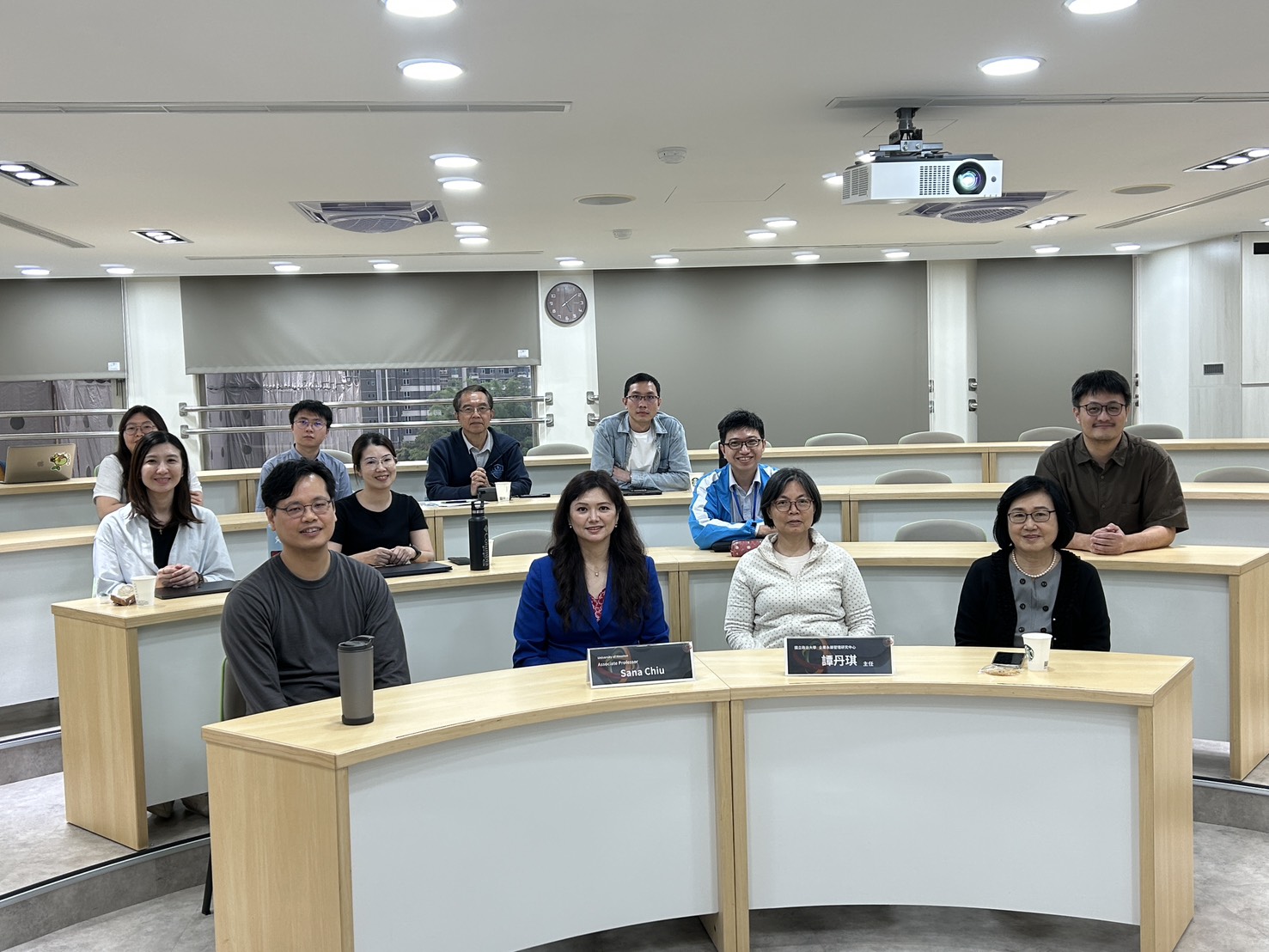
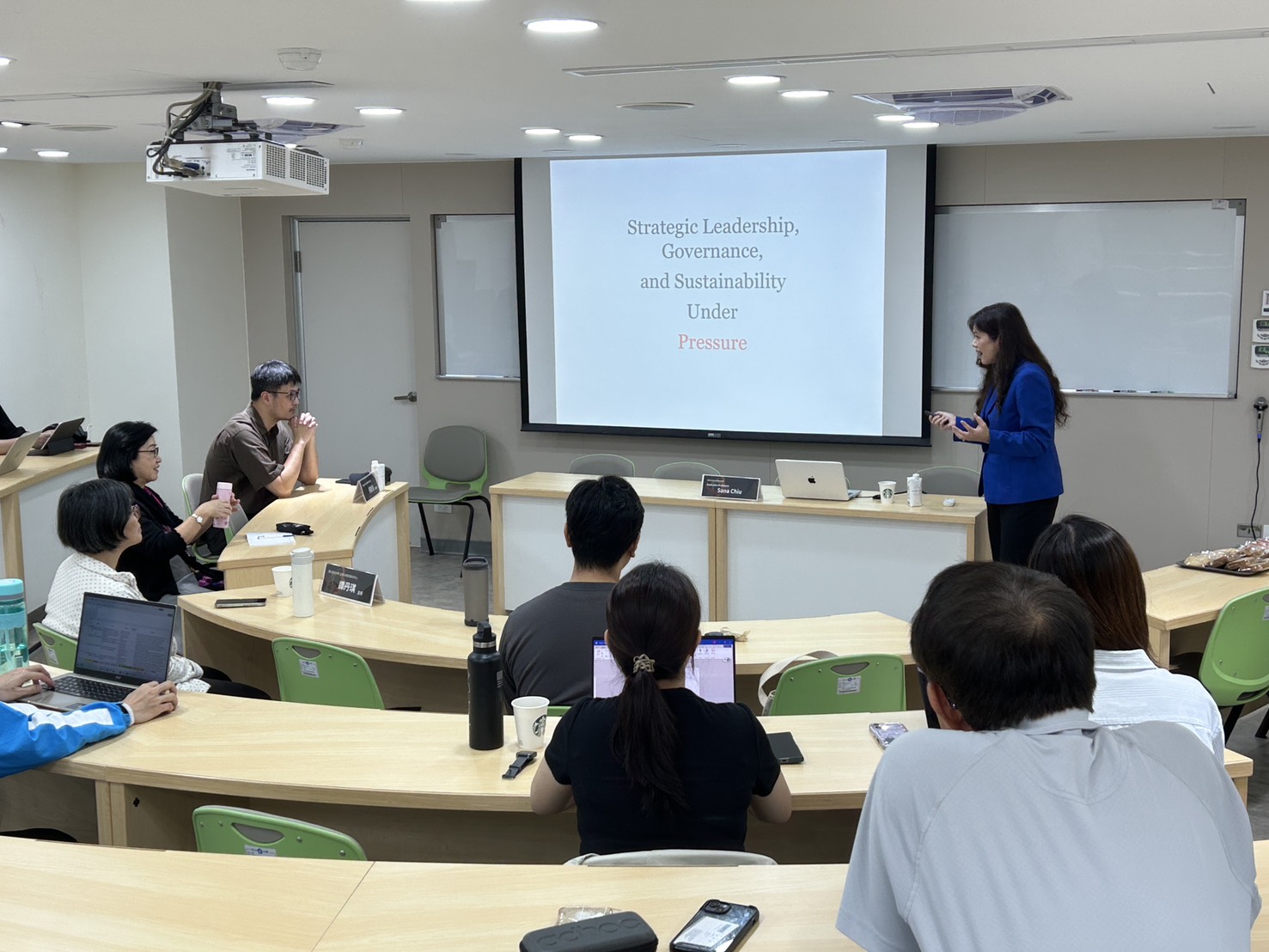
The Center for Business Sustainability at National Chengchi University recently invited Sana Chiu, Associate Professor at University of Houston, to Taiwan for a special lecture series. The lectures, titled “Strategic Leadership, Governance and Sustainability Under Pressure” and “Who is Really Writing Your Paper? Exploring Emerging AI Policy and Responsible Use in Management Research,” explored challenges in corporate sustainability governance as well as the impact of generative artificial intelligence (AI) on academic research and research ethics. The events attracted faculty members, students, and researchers from various fields, leading to lively discussions and meaningful exchanges.
In the first lecture on sustainability governance, Professor Chiu emphasized that promoting ESG initiatives is relatively easy when companies are financially stable and resource-rich. However, the true test of sustainable governance lies in whether firms remain committed to sustainability efforts during periods of financial pressure, regulatory retreat, or market uncertainty. She argued that sustainability should not merely serve as a branding or public relations strategy, but rather be regarded as a core “strategic capability” supported by long-term organizational systems and governance structures.
During the lecture, Professor Chiu shared research conducted on large U.S. corporations, using the Trump administration’s withdrawal from the Paris Agreement as a natural experiment to examine how firms responded to weakened environmental policy pressure. The findings showed that companies with board members possessing environmental expertise were less likely to scale back carbon reduction efforts under regulatory uncertainty. In contrast, boards dominated by financial expertise were more likely to prioritize short-term financial performance at the expense of sustainability investments. She further noted that multinational corporations and family-owned businesses often demonstrate stronger sustainability resilience due to their emphasis on long-term reputation and compliance with international regulatory standards.
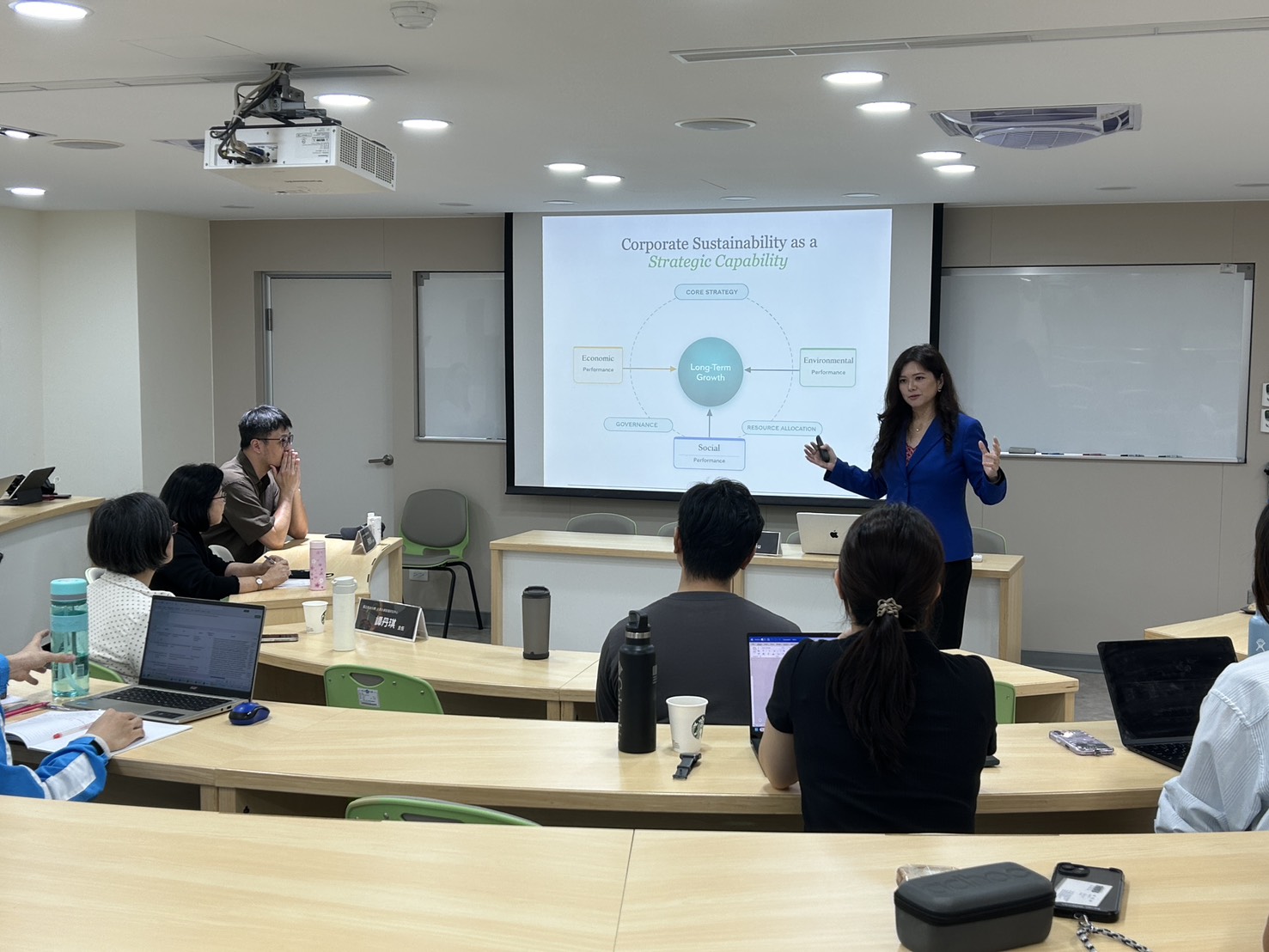
Professor Chiu also explained that executives under significant pressure may develop “tunnel vision,” causing decision-making to focus excessively on short-term outcomes while neglecting long-term sustainability risks and values. In this context, effective corporate governance serves not only as a monitoring mechanism but also as a critical support system that helps organizations maintain long-term strategic direction during periods of crisis. She stressed that while internal governance can help sustain ESG momentum, it cannot fully replace the role of public policy. Government policy signals remain one of the most influential drivers of corporate climate action and sustainability investment.
The second lecture focused on the opportunities and challenges brought by generative AI in academic research. Professor Chiu noted that since the rapid adoption of AI tools in 2023, academic journal submissions have increased significantly; however, the quality of research has not necessarily improved at the same pace. She observed that some AI-assisted papers, although polished and well-structured, often lack genuine theoretical insight and originality. This trend highlights the risk that excessive reliance on AI may weaken researchers’ critical thinking and intellectual independence.
She emphasized that AI can be a valuable tool for language editing, logical refinement, and data organization, but should never replace researchers in theoretical development, research design, or value judgment. “AI can help you write more clearly, but it cannot decide what questions truly matter,” she stated. According to Professor Chiu, the essential value of academic research lies in researchers’ ability to identify important problems and generate original insights.
Addressing the evolving AI policies of leading academic journals, Professor Chiu introduced recent guidelines established by top-tier journals such as Academy of Management Journal (AMJ) and Journal of Management Studies (JMS). She summarized three core principles: disclosure, accountability, and confidentiality. Researchers who use AI tools in their work should clearly disclose the platforms, versions, and purposes of use, while remaining fully responsible for all research content and conclusions. In addition, unpublished manuscripts and sensitive participant data should not be uploaded to public AI platforms in order to protect research ethics and intellectual property.
From a practical perspective, Professor Chiu encouraged researchers to treat AI as an “assistant” rather than a “co-author,” and recommended maintaining records of prompts and AI interactions to improve transparency and credibility throughout the research process. She also encouraged students and scholars to continue cultivating critical thinking, theoretical reasoning, and problem-awareness in the AI era, warning that overdependence on technological tools could undermine the core values of academic inquiry.
The Center for Business Sustainability at NCCU stated that the lecture series not only introduced cutting-edge international academic perspectives, but also prompted participants to rethink the relationship between sustainability governance, corporate decision-making, and emerging AI technologies. As global sustainability challenges and digital transformation continue to accelerate, maintaining long-term value under pressure and upholding academic integrity in the age of AI have become increasingly important issues for both corporations and researchers. The Center will continue to promote international academic exchange and interdisciplinary dialogue on sustainability governance and research ethics in the future.